What are the odds of this donor egg IVF cycle working?

Some people we’ve told about our current donor egg IVF attempt automatically assume that this cycle will work — that we will walk away with a baby. While we are certainly way more optimistic about this cycle than our previous three (non-donor-egg) cycles, unfortunately, the odds are still not 100%…not even close. So in the interest of managing everyone’s expectations, what are the odds of this donor egg IVF cycle working?

I won’t leave you in suspense: the answer is 25%.

Yep. 25%. Depressing, right?

Of course, the exact value will depend on the quality and quantity of eggs they get from our egg donor, Marie. But given her age and the number of eggs they aim for, we are going through all of this effort — multiple international flights, daily injections, disrupting four peoples’ work schedules, and spending thousands of euros — for a one-in-four shot. In other words, don’t get out your baby booty knitting pattern just yet.

So how is this value calculated? As I said above, the two main factors are egg quality and egg quantity. Egg quality decreases with age, where the AMH level can give a rough indication. Marie has a fairly normal AMH level for her age (even a bit above average), but she is still 36. So as high-quality as her eggs may be, we can’t expect them to compare with those of an 18-year-old.

By egg quantity, I mean the number of eggs that Marie grows during the stimulation cycle. I had previously read that they aimed for 10-12 eggs in an IVF cycle. However, apparently 15 eggs is already getting into the territory of ovarian hyper-stimulation syndrome (OHSS), which can cause complications for the donor (in addition to decreasing the quality of the resulting eggs). In order to steer clear of those complications (and since it’s not a very exact science), our clinic will aim for 6 eggs in this cycle. Combining this number of eggs with Marie’s age, we arrive at a 25% chance of it working.

All of this is nicely summarized by this chart from my doctor, which I snapped a (poor-quality) picture of at our last appointment. It shows the predicted live birth rate as a function of age and egg number. The important thing to notice is how the live birth rate starts decreasing again above 15 eggs. Even with a younger donor, this would limit our success rate to 30% (for 6 eggs) or 40% in the very best case of exactly 15 eggs.
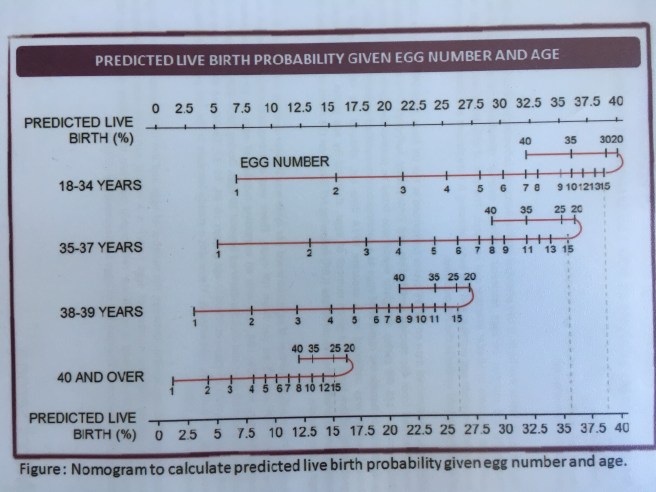
IVF live birth rate
Chart from our clinic showing predicted live birth rate as a function of number of eggs and donor age. Note that the success rate starts decreasing again for a large number of eggs, where ovarian hyper-stimulation syndrome (OHSS) can cause complications for the donor and affect egg quality.

In summary, not only are the odds not 100%, but it’s actually likely that this cycle won’t result in a baby. We will continue to be cautiously optimistic, but don’t expect me to be googling gender-reveal cake recipes quite yet.

What genetic diseases will our donor be screened for?

In just a few short days, our egg donor Marie and her husband will be flying in from the US for her screening appointments in Belgium. In addition to meeting with our doctor, a psychologist, the coordinating midwives, and etc, a big part of the jam-packed day will be a meeting with a geneticist. This geneticist will be searching for any genetic diseases that may preclude her from donating her eggs to us. But what genetic diseases will they be screening for, specifically?

There are four tests she needs to have, and the only one she’s had so far is the chromosome analysis. As I described in a previous post, Marie found out that this test can be done much more quickly in the US than Belgium, and she even convinced her doctor there to write up a lab order. However, we still weren’t sure if the results would come in before the screening appointments next week. We even had a bet about what would come back first: the results of the chromosome analysis, or her new passport. (I was betting that the passport would be the last to arrive, leaving us biting our nails until the very last minute.)

Well I lost…the passport came back first. But we also got the results of the chromosome analysis! All normal, as expected for that particular test given that she has two healthy kids. That leaves three more tests that she will need to have done when we’re in Belgium next week.

What are the additional tests?

The are three other diseases that they specifically screen for:

  • Fragile-X: A genetic disorder characterized by intellectual disability, behavioral challenges and certain physical traits like a long face. The likelihood of carrying this gene is higher for women, where approximately 1 in 151 are carriers.

  • Spinal Muscular Atrophy: A genetic disorder that affects the control of muscle movement. Approximately 1 in 50 people are carriers.

  • Cystic Fibrosis: A genetic disorder that causes severe damage to the lungs, digestive system, and other organs. Approximately 1 in 23 people are carriers.

We were a little shocked to learn the statistics for these, especially for cystic fibrosis. Even if Marie is totally healthy otherwise, and even though my husband would also have to be a carrier to result in the baby having a 1-in-4 chance of getting CF, they won’t let her donate if she’s a carrier.

Then is that it?

So if Marie passes all of these tests, then does she get the all-clear to donate? No, because as I’ve mentioned before, we’re apparently trying to create a genetically-flawless, award-winning baby.*

The geneticist will therefore also check her family history for a number of other inheritable diseases. They won’t say exactly what they’re looking for — I think partly because they know people would just lie if they knew. But I understand that a few of the ones on the no-fly list are breast cancer and other inheritable cancers, autism, and epilepsy.

If they do find any of those, then Marie’s out of the running, and it’s back to the drawing board for us. That would be extremely frustrating — to say the least — since most people with any number of issues can pop out a baby any time the mood strikes them. It would also be quite a blow since we had such a difficult time finding a donor in the first place. So let’s hope that doesn’t happen, and that we can move on to Stage 2 of creating this genetically-superior wonder-baby.

*(Unless my husband has any diseases, which they don’t care about in the slightest. It’s perfectly legal to pass down your own genetic problems to your baby. You just can’t give them someone else’s!)

I’m not ovaryacting* — AMH is cool

In a previous post on what it takes to be an egg donor, I mentioned that the very first hurdle is an ‘AMH’ test. But what is AMH? It stands for Anti-Müllerian Hormone, and it measures a woman’s ovarian reserve. I’m not being sarcastic — I actually do think it’s pretty cool. In fact, I was planning on doing a whole post on AMH, with lots of cool graphs showing it’s mean and 90th percentile values as a function of age, etc.

And then I realized that nobody wants to read that.

It’s fine! I’m not offended. I probably wouldn’t read a blog post with graphs related to your specific medical condition either. No offense.

But 1 in 8 women struggle with infertility. Sure — there are many other factors which also affect fertility — but low ovarian reserve can be a major factor for some of those women, and it’s also something that ALL women will face at some point in their lives (just hopefully after they’re done having kids).

So instead of bombarding you with graphs, here are three simple facts about AMH:

  1. It measures both the quantity and quality of follicles left in one’s ovaries.
  2. It’s typically around 3 (ignoring the ng/ml units) for women under 30, but it falls sharply toward zero between 30-50 years.
  3. It’s much more stable over the course of a monthly cycle than the other hormones that can probe ovarian reserve, making it a more reliable tracer.

I’m not a (medical) doctor, but I do wonder why — if this simple blood test is so powerful — it’s not something that is typically done earlier. It took me visiting three different fertility clinics in three different countries before mine was finally tested. And lo-and-behold, it was vanishingly small. Like, over an order of magnitude lower than average.

Hence the ovarian failure diagnosis. Again, this is something every woman eventually goes through. Women with premature ovarian failure (like me) just happen to be a decade or two earlier than most.

What is the AMH requirement for donors?

In Belgium, we were told that our egg donor had to have an AMH level between 2-6, where the high end of the range puts those (apparently) very fertile women at risk for additional complications. Marie’s test result came back at 2.16. Within range!

At first, I think Marie was a bit disappointed that her level wasn’t higher. (Marie is an overachiever — another trait we share). But according to the graphs I already agreed not to bore you with, she’s actually above average for her age. Her level is also ~15x higher than mine, which sounds pretty darn good to me.

So what are the odds of this donation cycle actually working? Well, for women with an AMH level <0.5 (like mine), a (normal) IVF cycle will only make it to embryo transfer 1/3 of the time, and those embryos have an even smaller chance than normal of sticking. The good news is that with an AMH level >2 (like Marie has), studies suggest that an IVF cycle will result in an embryo transfer 99% of the time.

Of course, having an embryo to transfer is a necessary — but not sufficient — step toward a full-blown pregnancy. The exact probability at that stage depends on many factors, including number of embryos transferred, embryo quality, and whether it was a 3- or 5-day transfer. More on that to come.

In summary (TL;DR), Marie’s AMH is above average for her age, so that’s about the best we can hope for. Also, if you are a woman struggling to conceive, ask your doctor to check your AMH.

Reference: For more fun facts about AMH, see IVF1

*The title was borrowed from justovaryacting.com

A passport & a plan

When my friend, Marie, offered to donate her eggs to us, I knew that the timing would be critical. There’s a strict sequence of events that must be followed for egg donations, starting with the hormone test, then the STD/genetic tests, then the in-person screenings with the geneticist/psychologist/President of the EU (maybe not that last one?…it’s all a bit confusing…), followed by a ‘try-cycle’ to see how my body responds to the new drugs, and finally the actual donation cycle itself. One of the genetics tests (the chromosome analysis) can take up to three months to get back, and the results have to be in before they’ll let me even start the ‘try-cycle’. To make things more complicated, Marie lives across a fairly large ocean, and we’re trying to get this all done over her summer teaching break, which starts soon and ends in August!

I was guessing the chromosome analysis might be something that Marie could get done slightly faster in the US, since privatized healthcare = more expensive = better customer service. Sure enough, after about a zillion phone calls, multiple in-person visits, and an appointment with a very sympathetic doctor, Marie managed to get a lab order for the test to be done there, and she was told it’d only take two weeks(!) This sounds suspiciously short, so we’re still not completely sure this is the right test — due partly to some translation issues with the original (Dutch) order from Belgium, but mostly just to how medical protocols don’t necessarily cross international borders. When Marie asked for the technical reason behind the surprisingly large timescale discrepancy between the US and Belgium, the secretary helpfully responded <cue strong southern accent>: “Well, that’s a different country.”

The next logistical hurdle was scheduling the in-person screenings with the geneticist/psychologist/Dalai Lama. The earliest appointments available weren’t until July, which would delay the donation cycle itself until at least September. Luckily, I happened to be in Belgium at the time for my last ‘natural’ IVF cycle, and the egg donation nurse was kind enough to see me without a pre-scheduled appointment. She took pity on our predicament, and she managed to convince all the various doctors/world leaders to see us on a much shorter timescale (“Her donor is coming from America.”) I left her office with six back-to-back appointments scheduled for this coming 16 May, and a prayer that Marie would actually be available.

Marie was available, luckily, as was her husband, who also has to come for the screenings. (I really wish I could go back and tell my 21-year-old self that it would eventually take four adults, a team of doctors, and multiple international flights to get me pregnant.) Marie checked that their passports weren’t expired, and we bought the round-trip tickets for their whirlwind 2-night trip to Amsterdam. What she didn’t notice until several days later was the name on the passport…her maiden name. What followed were a bunch of frantic texts referencing travel.state.gov and the expedited passport renewal section.

All of this is to say that we currently have a plan, and hopefully in 8-10 working days, we will also have a passport.

Thanks

The response to this blog has been overwhelming, so I just wanted to take a moment and thank everyone for reading it.

I know that for many of you, reading a blog about infertility is not exactly how you’d normally choose to spend your leisure time. Then again, I never thought I’d be writing a blog about infertility, and yet here we are

For those of you who don’t know our donor, Marie, I want you to know that she’s totally on board with me writing about all of this. She even gave me the push to finally start it. I’d been thinking about starting a blog for a while, but until recently, it would have been all too doom-and-gloom. Obviously we’re still grieving that ‘natural’ IVF didn’t work out for us, but we’re also hopeful that this new path — egg donation — will be more successful. After all, Marie had both her kids on the first try, so her eggs are clearly top-quality. (If you could buy them at the grocery store, they would be those expensive cage-free organic ones.)

Just to be clear, Marie and I are also both chronic over-sharers, which Marie calls a ‘personality flaw’ and I call a ‘character asset’.

I also want to be clear that I don’t think I’m the first person in the world who has ever had this idea. When I told a (similarly fertility-challenged) friend about the blog, she said “Great, I’ll add it to my Saturday morning infertility reading list”, and she wasn’t even being sarcastic. There are many other great infertility blogs already out there written by fellow ‘IVF warriors’, like The Infertility Voice, Life Without Baby, Dreaming of Diapers, and (my personal favorite for best title) The Impregnable Woman.

There’s also a ‘National Infertility Awareness Week’, which, by coincidence, was this week. #NIAW

I’m really hoping this blog will be a short-lived pursuit, only necessary to keep our family/friends in the loop during this (last??) crazy leg of the journey. But I’m also a scientist — I understand the statistics — and I fully understand that it very well may not be. So thank you again for reading & following — your support means the world to us.

What does it take to be an egg donor?

The requirements for egg donors are different everywhere, so I can only talk about what it takes at the hospital where we’re being treated in Belgium. After a bit of research, some of the criteria seem to be more-or-less universal (e.g., no family history of severe hereditary diseases), while others (e.g., age limit) will depend on the specific country/clinic.

The first thing to know is that there are two types of donation:

  1. Direct: where you donate eggs directly to someone you know, or
  2. Anonymous: where you donate eggs to an ‘egg bank’.

Here in Belgium, the egg bank is only available to Belgian citizens (due to a shortage of donors). For us, that meant that we had to find our own donor. However, that donor could choose to either donate directly to us, or they could donate anonymously to the egg bank, which would then give us ‘credit’ to use the egg bank anonymously.

Both options appeal to different people for different reasons. Some donors may find it psychologically difficult to see their genes being raised in another family, and they may then prefer anonymous donation. On the other hand, some donors may prefer to donate directly to their friends/family. We left it up to our donor, Marie, who has chosen the latter (direct donation). Obviously we’re still sad we can’t just use my own eggs (as we both happen to think I’m a pretty neat person), but given the circumstances, we would have been happy with either choice. And since we also think Marie is a pretty neat person, we feel we’ve won the egg donation lottery (if it all works, of course).

Before the donation can occur, however, the prospective donor must meet a number of criteria and test negative for about a dozen diseases. Though these are not strict rules for direct donation, the clinic strongly advises that the donor be under 37 years old, that they have had children, and that they not desire more (so they won’t regret handing over some of their potentially fertile eggs). Maybe it’s because of the circles we run in (academics and/or other expats), but finding a donor that met all of these criteria was extremely difficult for us. Before Marie volunteered, we had basically given up hope!

If the prospective donor meets these first criteria, then the next hurdle is a hormone test. There’s a pretty cool blood test they can do nowadays (‘AMH’) that tells you about your ovarian reserve. Obviously, there’s no point in going through the whole process if the donor is also low on eggs. Luckily, Marie already passed this with flying colors.

Then come the dozen-or-so tests for STDs and genetic diseases, including a chromosome analysis, as we’re apparently attempting to create a genetically perfect, award-winning being. These tests can be quite pricey for the hopeful couple, and do not seem to be covered by our Dutch insurance (still a lot cheaper than in the US, though!) They can also take up to three months to get the results back, and should thus be done as early as possible.

Next are the in-person screenings with a geneticist, a psychologist, and the coordinating nurse. Here, they create a detailed family tree for the donor, attempting to suss out any hereditary illnesses, and to assess the psychological fitness of the donor. Only if the donor passes ALL of these hurdles can the donation itself proceed (which itself is a multi-week process including hormone injections, and ending with a surgery — more on all this later).

I list all of these steps not to scare away potential donors, but rather to highlight how difficult it can be to find someone who is both willing and able. Particularly in countries where donors aren’t allowed to be paid (like here in Belgium), this can lead to a shortage of donors, making anyone who is willing/able that much more valuable. We’re grateful that Marie is willing to go through all this for us. She had her blood test yesterday for the STDs and chromosome analysis, so now we sit back and wait for the lab results!