Our egg donation IVF test run

Back in April, my friend Marie volunteered to be our egg donor to help us try to get pregnant. Since then, she has undergone a battery of blood tests to check her hormone levels/rule out STDs/screen her for genetic diseases, and she and her husband flew over to Europe from the US in a whirlwind trip to have their in-person screenings. Assuming that she gets approved (which we’re still waiting to hear…), the actual egg donation IVF cycle still won’t happen until mid-July at the very earliest.

So why does it take so long? Well, unlike normal people who only have to get drunk to procreate (or so I’m told), there are about a gazillion steps we have to go through for this whole process, and we’re currently only on step #8,341 or so: the test cycle. Some clinics (including ours) require you to do a ‘try-cycle’ before the actual egg donation cycle to make sure that your body responds well to the drugs. “But wait…”, you’re probably thinking, “…Didn’t you already do three IVF cycles?” Yes. Yes I did. (#ivfwarrior). So why is it necessary for me to do another?

The thing is that an egg donation IVF cycle is very different from a ‘regular’ IVF cycle. In a regular (i.e. non-donation) cycle, you grow your own eggs within follicles in your ovaries, and that process itself is actually what stimulates your endometrium (aka uterine lining) to grow. In an egg donation cycle, nothing grows in your ovaries, because your donor is doing that part for you. In fact, they even give you medication to turn off your ovaries entirely, just to make sure that nothing jeopardizes the donation cycle. That means they need to give you other medication (estrogen, basically) to grow your endometrium. And that’s the part they want to test, because it’d be a huge bummer if your donor goes through all the work of producing eggs for you, and then your uterus isn’t in prime condition to receive one.

It’d be like: after years of getting the recipe wrong, the dough is finally ready, but you forgot to turn the oven on.

How often does the test cycle fail?

I asked our Belgian egg donation nurse, Bernadette, how often the egg donation test cycle shows issues, and she guesstimated about 40% of the time. They test this with a vaginal ultrasound to look at the thickness and structure of the endometrium after 12-14 days on the estrogen pills. If it’s not thick enough, or if it doesn’t show the desired ‘triple-line’ structure in the ultrasound, then you have to wait and test again, possibly with some changes to the medication. That obviously sets the schedule back even further.

I’ve been on the estrogen pills for 10 days now — three times a day — and I’ve scheduled my ultrasound for this coming Tuesday — right at the 12 day mark. We’re really hoping everything looks acceptable, because then we might still be able to do the real egg donation IVF cycle (mostly) over Marie’s summer teaching break. Then we can move on to steps #8,342–8,344 of the process: five days of another new medication for me; then waiting for my cycle to start; then (this one will surprise you) the very non-intuitive step of taking birth control pills. Because if we could just use our intuition to get pregnant, we wouldn’t be in this pickle!
What does donor egg IVF entail?

I’ve been busily blogging these last few weeks about our current donor egg in-vitro fertilization (IVF) attempt, just naively assuming that everyone else already knows what that means. Then last week, two friends (and avid blog readers) asked me who will carry the baby if we get to that stage. Great question! And one I should have addressed earlier. Sometimes I forget that other people don’t also spend their every waking hour reading about, preparing for, or talking about IVF. With three failed ‘normal’ attempts under my belt, as well as our latest foray into donor egg IVF, I’m basically an expert. So please allow me to explain what donor egg IVF is, and how it differs from regular IVF.*

So in a regular IVF cycle, you only need two people: a man and a woman. It begins with the woman taking medication to stimulate follicle growth (‘stims’ if you want to be hip with the IVF lingo). This comes in the form of a liquid that is injected into the thigh or (if you’re super hardcore) the stomach. The woman also takes a medication to suppress ovulation, so that it can be triggered at exactly the right time. This may be a nose spray which makes one feel like one has continuous post-nasal drip, or it may be another injection which needs to be mixed first by breaking a glass vial, because obviously that’s very safe and I’ve definitely never cut myself doing that.**

The woman does these ‘stimming’ injections every day for around two weeks, depending on the specific protocol. After the first ~5 days, she needs to have a blood test and a vaginal ultrasound every couple days. The ultrasound technician will check how the uterine lining is developing, as well as how many follicles are growing in each ovary, if there are any. (Normally only one follicle will develop to maturity in a non-IVF cycle, but the idea of the ‘stims’ is to increase the odds by growing multiple follicles.) The technician will record the number of follicles in each ovary and, if any are larger than 10mm, they will record the size. Or, if you’re like me and don’t grow (m)any follicles, this may turn into a game of ‘find the ovary’.

Once the biggest (‘lead’) follicle reaches a size of around ~20mm, the doctor will have the woman ‘trigger’ ovulation by taking another medication. This is also an injection, again administered in the thigh or stomach (because the woman probably hasn’t had enough needles poked into her recently). This must be taken exactly 36 hours before the egg retrieval surgery, so that the follicles will be nice and mature, but not yet bursting.

The man’s big moment to shine comes the next morning, when he deposits a sperm sample at the hospital. Then, exactly 36 hours after the trigger injection, the woman has the egg retrieval surgery. This is a relatively minor surgery (though it does involve more needles), and I will describe it in more detail in another post.

How does donor egg IVF differ?

In the case of donor egg IVF, you need an additional woman: the egg donor. The main difference is that almost all of the steps I’ve described so far then apply to the woman who is donating eggs, rather than the hopeful mother. The other difference is that the hopeful mother also takes medication (but in this case, to inhibit follicle growth) and has regular ultrasounds to check her uterine lining, since it is she who will (hopefully) carry the baby — not the donor. That means that after the egg retrieval, the donor’s part is done.

All of the subsequent steps (waiting to hear how many eggs are mature, waiting to hear how many eggs fertilize, waiting to hear how many embryos develop, and more waiting to hear if there are any to be placed back in and any extras to be frozen) are the same for both normal and donor egg IVF. If an embryo makes it to transfer, then it is placed in the hopeful mother with what is essentially a high-tech turkey baster. That kicks off the final stage of waiting: waiting to see if the embryo sticks and develops into a baby.

*Note that I’m only referring to actual in-vitro fertilization (IVF) here, not intra-uterine insemination (IUI), a less invasive procedure which is often tried before resorting to IVF.

**I’ve definitely cut myself twice breaking the glass vial. I can’t imagine this is legal in the US…

A big week: egg donor screening

Last week was a big week. Our egg donor, Marie, flew all the way from the US to Europe with her husband. His mother flew to their home from a different state to watch their kids (along with her mother) while they were away (because apparently it takes a village for us to even have a baby). And directly after meeting them at the airport for their evening arrival, my husband, Marie, her husband, and I rented a car and drove the 2+ hours directly to Belgium to get a quick night’s sleep before our marathon schedule of donor egg IVF screening appointments the next morning.

Given the potential for complications, I think it all went relatively smoothly. Maybe it’s because they have two small children, but Marie and her husband were champs even with so little sleep. After flying all night and going to sleep after midnight the following day, they were up by 7:30 and we were checked out of the Airbnb by 8:15. We got everyone checked in at the hospital, where my husband and I had an appointment at 9am with the psychologist and Marie and her husband had an appointment with the geneticist. We then met with the egg donation nurse while they had appointments with the psychologist and fertility doctor. Finally, we all had a joint appointment with the egg donation nurse. Just typing it all out again is making me tired.

All of the appointments went quite well, at least as far as I can tell. The psychologist didn’t bring up anything that we hadn’t already considered in detail. I had already mourned my fertility (for the most part), and I also already knew about ‘early telling’, the recommended method for telling your kid they are a donor egg baby. Marie said their appointment with the psychologist was also quite pleasant, and thanks to the detailed emails she and I have been sending back and forth, there were no surprises in their appointment with the fertility doctor.

The geneticist was the big wild card, as we had been warned she could be quite strict. However, Marie said that appointment also went very smoothly. She seemed happy with the lack of major hereditary diseases in Marie’s family tree, so the in-depth medical history Marie’s mom had done proved unnecessary. And we even got some good news: although we had previously been led to believe that Marie would be unable to donate if she was a carrier for cystic fibrosis (CF) or spinal muscular atrophy (SMA), the geneticist clarified that it would only be a problem if my husband is a carrier too (which makes soooo much more sense).

After Marie got her blood drawn for the CF and SMA tests, we all met with the egg donation nurse, a miracle-worker by the name of Bernadette. She’s the one who had arranged for us to come in May for all this, as the earliest opening they had at the time was not until July. She also ends all of her sentences in ‘voilà!’ For example, “And then the needle punctures the ovary, and voilà!” Obviously we love her.

Figuring out the timeline with Bernadette proved the trickiest part of the day. There are a bunch of things that need to happen before the actual donation cycle, so it’s sort of impossible to predict when that might occur (assuming Marie gets approved, which we won’t know until her latest blood test results come back and the various doctors present their findings at the bi-monthly staff meeting). One of the biggest uncertainties is where I am currently in my cycle (which, thanks to my condition, is less of a “cycle” and more of a random walk). Here, Bernadette once again saved the day by arranging a spur-of-the-moment ultrasound, then whipping out a needle and drawing blood from my arm right there in her office. Voilà!

After the appointments (and 4+ hours at the hospital), we drove directly back to Holland so we could return the rental car on time. Marie and her husband then had <24 hours at our house before their flight back home. All-in-all, they were on the ground for 48 hours and in the air for 20. It was a whirlwind trip, but despite the intense schedule and lack of sleep, I think we can call it a success. In her classic straight-shooter fashion, Marie even texted me from the airport:

“Can’t wait to return! Vaginal procedure and all!”

What are the odds of this donor egg IVF cycle working?

Some people we’ve told about our current donor egg IVF attempt automatically assume that this cycle will work — that we will walk away with a baby. While we are certainly way more optimistic about this cycle than our previous three (non-donor-egg) cycles, unfortunately, the odds are still not 100%…not even close. So in the interest of managing everyone’s expectations, what are the odds of this donor egg IVF cycle working?

I won’t leave you in suspense: the answer is 25%.

Yep. 25%. Depressing, right?

Of course, the exact value will depend on the quality and quantity of eggs they get from our egg donor, Marie. But given her age and the number of eggs they aim for, we are going through all of this effort — multiple international flights, daily injections, disrupting four peoples’ work schedules, and spending thousands of euros — for a one-in-four shot. In other words, don’t get out your baby booty knitting pattern just yet.

So how is this value calculated? As I said above, the two main factors are egg quality and egg quantity. Egg quality decreases with age, where the AMH level can give a rough indication. Marie has a fairly normal AMH level for her age (even a bit above average), but she is still 36. So as high-quality as her eggs may be, we can’t expect them to compare with those of an 18-year-old.

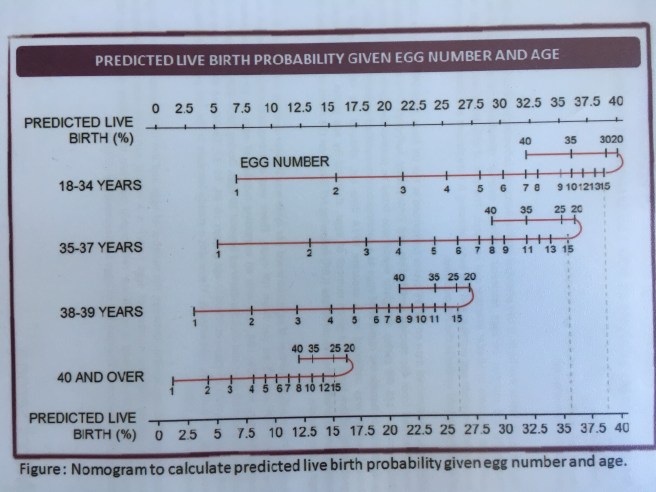
By egg quantity, I mean the number of eggs that Marie grows during the stimulation cycle. I had previously read that they aimed for 10-12 eggs in an IVF cycle. However, apparently 15 eggs is already getting into the territory of ovarian hyper-stimulation syndrome (OHSS), which can cause complications for the donor (in addition to decreasing the quality of the resulting eggs). In order to steer clear of those complications (and since it’s not a very exact science), our clinic will aim for 6 eggs in this cycle. Combining this number of eggs with Marie’s age, we arrive at a 25% chance of it working.

All of this is nicely summarized by this chart from my doctor, which I snapped a (poor-quality) picture of at our last appointment. It shows the predicted live birth rate as a function of age and egg number. The important thing to notice is how the live birth rate starts decreasing again above 15 eggs. Even with a younger donor, this would limit our success rate to 30% (for 6 eggs) or 40% in the very best case of exactly 15 eggs.

IVF live birth rate
Chart from our clinic showing predicted live birth rate as a function of number of eggs and donor age. Note that the success rate starts decreasing again for a large number of eggs, where ovarian hyper-stimulation syndrome (OHSS) can cause complications for the donor and affect egg quality.

In summary, not only are the odds not 100%, but it’s actually likely that this cycle won’t result in a baby. We will continue to be cautiously optimistic, but don’t expect me to be googling gender-reveal cake recipes quite yet.

What genetic diseases will our donor be screened for?

In just a few short days, our egg donor Marie and her husband will be flying in from the US for her screening appointments in Belgium. In addition to meeting with our doctor, a psychologist, the coordinating midwives, and etc, a big part of the jam-packed day will be a meeting with a geneticist. This geneticist will be searching for any genetic diseases that may preclude her from donating her eggs to us. But what genetic diseases will they be screening for, specifically?

There are four tests she needs to have, and the only one she’s had so far is the chromosome analysis. As I described in a previous post, Marie found out that this test can be done much more quickly in the US than Belgium, and she even convinced her doctor there to write up a lab order. However, we still weren’t sure if the results would come in before the screening appointments next week. We even had a bet about what would come back first: the results of the chromosome analysis, or her new passport. (I was betting that the passport would be the last to arrive, leaving us biting our nails until the very last minute.)

Well I lost…the passport came back first. But we also got the results of the chromosome analysis! All normal, as expected for that particular test given that she has two healthy kids. That leaves three more tests that she will need to have done when we’re in Belgium next week.

What are the additional tests?

The are three other diseases that they specifically screen for:

  • Fragile-X: A genetic disorder characterized by intellectual disability, behavioral challenges and certain physical traits like a long face. The likelihood of carrying this gene is higher for women, where approximately 1 in 151 are carriers.

  • Spinal Muscular Atrophy: A genetic disorder that affects the control of muscle movement. Approximately 1 in 50 people are carriers.

  • Cystic Fibrosis: A genetic disorder that causes severe damage to the lungs, digestive system, and other organs. Approximately 1 in 23 people are carriers.

We were a little shocked to learn the statistics for these, especially for cystic fibrosis. Even if Marie is totally healthy otherwise, and even though my husband would also have to be a carrier to result in the baby having a 1-in-4 chance of getting CF, they won’t let her donate if she’s a carrier.

Then is that it?

So if Marie passes all of these tests, then does she get the all-clear to donate? No, because as I’ve mentioned before, we’re apparently trying to create a genetically-flawless, award-winning baby.*

The geneticist will therefore also check her family history for a number of other inheritable diseases. They won’t say exactly what they’re looking for — I think partly because they know people would just lie if they knew. But I understand that a few of the ones on the no-fly list are breast cancer and other inheritable cancers, autism, and epilepsy.

If they do find any of those, then Marie’s out of the running, and it’s back to the drawing board for us. That would be extremely frustrating — to say the least — since most people with any number of issues can pop out a baby any time the mood strikes them. It would also be quite a blow since we had such a difficult time finding a donor in the first place. So let’s hope that doesn’t happen, and that we can move on to Stage 2 of creating this genetically-superior wonder-baby.

*(Unless my husband has any diseases, which they don’t care about in the slightest. It’s perfectly legal to pass down your own genetic problems to your baby. You just can’t give them someone else’s!)

I’m not ovaryacting* — AMH is cool

In a previous post on what it takes to be an egg donor, I mentioned that the very first hurdle is an ‘AMH’ test. But what is AMH? It stands for Anti-Müllerian Hormone, and it measures a woman’s ovarian reserve. I’m not being sarcastic — I actually do think it’s pretty cool. In fact, I was planning on doing a whole post on AMH, with lots of cool graphs showing it’s mean and 90th percentile values as a function of age, etc.

And then I realized that nobody wants to read that.

It’s fine! I’m not offended. I probably wouldn’t read a blog post with graphs related to your specific medical condition either. No offense.

But 1 in 8 women struggle with infertility. Sure — there are many other factors which also affect fertility — but low ovarian reserve can be a major factor for some of those women, and it’s also something that ALL women will face at some point in their lives (just hopefully after they’re done having kids).

So instead of bombarding you with graphs, here are three simple facts about AMH:

  1. It measures both the quantity and quality of follicles left in one’s ovaries.
  2. It’s typically around 3 (ignoring the ng/ml units) for women under 30, but it falls sharply toward zero between 30-50 years.
  3. It’s much more stable over the course of a monthly cycle than the other hormones that can probe ovarian reserve, making it a more reliable tracer.

I’m not a (medical) doctor, but I do wonder why — if this simple blood test is so powerful — it’s not something that is typically done earlier. It took me visiting three different fertility clinics in three different countries before mine was finally tested. And lo-and-behold, it was vanishingly small. Like, over an order of magnitude lower than average.

Hence the ovarian failure diagnosis. Again, this is something every woman eventually goes through. Women with premature ovarian failure (like me) just happen to be a decade or two earlier than most.

What is the AMH requirement for donors?

In Belgium, we were told that our egg donor had to have an AMH level between 2-6, where the high end of the range puts those (apparently) very fertile women at risk for additional complications. Marie’s test result came back at 2.16. Within range!

At first, I think Marie was a bit disappointed that her level wasn’t higher. (Marie is an overachiever — another trait we share). But according to the graphs I already agreed not to bore you with, she’s actually above average for her age. Her level is also ~15x higher than mine, which sounds pretty darn good to me.

So what are the odds of this donation cycle actually working? Well, for women with an AMH level <0.5 (like mine), a (normal) IVF cycle will only make it to embryo transfer 1/3 of the time, and those embryos have an even smaller chance than normal of sticking. The good news is that with an AMH level >2 (like Marie has), studies suggest that an IVF cycle will result in an embryo transfer 99% of the time.

Of course, having an embryo to transfer is a necessary — but not sufficient — step toward a full-blown pregnancy. The exact probability at that stage depends on many factors, including number of embryos transferred, embryo quality, and whether it was a 3- or 5-day transfer. More on that to come.

In summary (TL;DR), Marie’s AMH is above average for her age, so that’s about the best we can hope for. Also, if you are a woman struggling to conceive, ask your doctor to check your AMH.

Reference: For more fun facts about AMH, see IVF1

*The title was borrowed from justovaryacting.com